Skip to content
Back to the product range

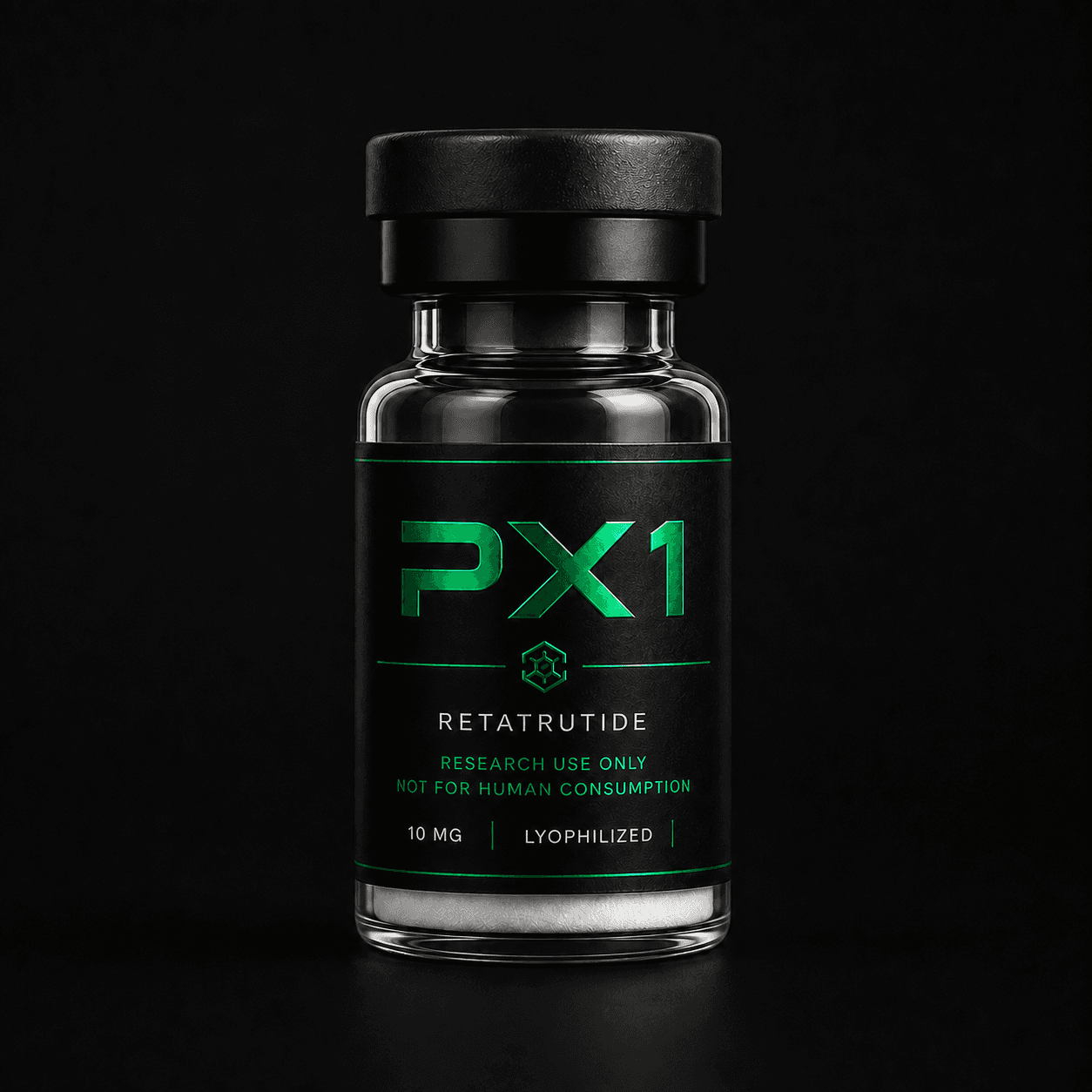
PX1 / 10 mg

Retatrutide

An investigational molecule studied across three metabolic signaling pathways.

10 mgWeight

For research use only. Not intended for human use.

The research information on this page describes published studies about the molecule and does not demonstrate the effect, safety, purity, or quality of PX1Labs' research material.
01

What is it?

10 mg

Retatrutide is an investigational peptide and triple agonist acting at GIP, GLP-1 and glucagon receptors.

60 sec

In simple terms

Retatrutide is still being studied. Scientists are testing how it sends three different signals linked with hunger, blood sugar and how the body uses energy. It is not an approved medicine, and a study result cannot prove what is in a particular vial or how that vial affects a person.

Retatrutide / explained

Retatrutide, clearly explained

The repeated themes across the 30 submitted graphics are consolidated into 15 checked cards. Swipe from the basics through trial results and safety.

  • What it is01 / 15

    What is retatrutide?

    It is an investigational molecule that activates three metabolism-related receptors: GIP, GLP-1 and glucagon. It is still under study and is not an approved medicine.

  • Mechanism02 / 15

    What does “triple agonist” mean in plain language?

    3

    GIP · GLP-1 · glucagon

    Think of a receptor as a switch. An agonist turns it on. Retatrutide signals through three switches, but more targets do not automatically mean a better outcome.

  • Biology03 / 15

    What does the GLP-1 pathway do?

    GLP-1 participates in signals for fullness, gastric emptying and the insulin response after eating. In retatrutide research, it acts alongside two other pathways.

  • Biology04 / 15

    Why does retatrutide include GIP?

    GIP is a gut hormone involved in the insulin response after eating. Researchers are studying what happens when this signal is combined with GLP-1 and glucagon pathways.

  • Mechanism05 / 15

    Why include the glucagon pathway?

    The glucagon-receptor pathway is studied in relation to energy expenditure and fat metabolism. Its independent contribution to human outcomes has not been fully separated.

  • Simple picture06 / 15

    Is the research about appetite or metabolism?

    Both. GLP-1 and GIP relate to appetite, fullness and glucose response; the glucagon pathway adds a question about energy use. No single pathway explains the whole result.

  • Trial result07 / 15

    What was the mean weight change in the Phase 2 trial?

    −24.2%

    48 weeks · Phase 2

    In the 48-week trial, mean body-weight change in the highest studied group was −24.2%. That is a group mean in a controlled trial, not a promise for an individual.

  • Cross-trial view08 / 15

    How do the semaglutide and retatrutide figures relate?

    Semaglutide · STEP 1

    −14.9% / 68 wk

    Retatrutide · Phase 2

    −24.2% / 48 wk

    STEP 1 semaglutide and Phase 2 retatrutide results come from separate trials with different durations and protocols. They cannot establish a direct ranking.

    Separate studies — not a head-to-head comparison.

  • Liver fat09 / 15

    What did the MASLD substudy report?

    up to −82.4%

    relative change · 24 weeks

    At 24 weeks, the highest studied groups showed mean relative liver-fat reductions of roughly 81–82%. This was a smaller substudy, not evidence of every person's outcome.

  • Timeline10 / 15

    Had the weight-change curve stopped at week 48?

    The trial authors noted that the curve in higher studied groups did not appear to have reached a plateau by week 48. That does not predict how long change would continue.

  • Safety11 / 15

    What was most commonly reported in the trial?

    The most common adverse events were gastrointestinal and mostly mild to moderate. They occurred more often in higher studied groups; increases in heart rate were also reported.

  • Research 10112 / 15

    What does Phase 2 mean?

    Phase 2 looks for a signal of potential effect and studies safety in selected groups. It is not final confirmation or regulatory approval.

  • Context13 / 15

    Is retatrutide simply a stronger Ozempic?

    Semaglutide

    GLP-1

    Retatrutide

    GIP + GLP-1 + glucagon

    That is not an accurate description. Semaglutide activates the GLP-1 receptor; retatrutide is studied as a GIP, GLP-1 and glucagon triple agonist. They are different molecules in different trials.

  • Quality14 / 15

    What can actually verify purity?

    A label or generic percentage claim does not verify vial contents. Relevant verification needs lot-specific documentation; a clinical trial of the molecule does not establish a sales vial's identity or quality.

  • Big picture15 / 15

    Why are researchers interested in retatrutide?

    It combines three signaling pathways in one molecule. The research question is whether their interaction can expand what we learn about body weight, glucose and fat metabolism.

These cards describe published research and current regulatory status. They are not instructions for use or proof of a particular vial's contents, quality or effect.

02

What is being studied?

  1. 01

    Body-weight change in clinical trials

  2. 02

    Glucose and metabolic measures

  3. 03

    Safety and adverse events over longer follow-up

Retatrutide / scientific overview

A metabolic signal studied across three receptors

Retatrutide (LY3437943) is an investigational triple agonist that activates GIP, GLP-1 and glucagon receptors. This combination is studied in the context of appetite and satiety signaling, glucose metabolism, energy expenditure and fat oxidation. These mechanisms describe the investigational molecule, not a proven effect of a PX1Labs vial.

How the three signaling pathways are studied

Role in research · Important context
Signal
GLP-1
Role in research
Associated with satiety signaling, slower gastric emptying and glucose-dependent insulin response.
Important context
Clinical trials assess it together with the other receptor pathways, not in isolation.
Signal
GIP
Role in research
Participates in post-meal insulin response and glucose and lipid metabolic signaling.
Important context
Retatrutide research examines the potential interaction between GIP and GLP-1.
Signal
Glucagon
Role in research
Studied in relation to energy expenditure, lipolysis and fatty-acid oxidation.
Important context
Mechanistic evidence for fat oxidation is partly preclinical; its independent contribution in humans is not fully established.

Research highlights

mean body-weight change in the 12 mg group at 48 weeks in the Phase 2 obesity trial
−24.2%
largest mean HbA1c change at 36 weeks in the Phase 2 type 2 diabetes trial
−2.16 pp
relative liver-fat change in the 12 mg group at 24 weeks in the MASLD substudy
−82.4%

Clinical evidence

Phase · Duration · Published result
Population
Obesity or overweight without diabetes
Phase
Phase 2
Duration
48 weeks
Published result
Mean body-weight change was −22.8% in the 8 mg group and −24.2% in the 12 mg group.
Population
Type 2 diabetes
Phase
Phase 2
Duration
36 weeks
Published result
HbA1c decreased by up to 2.16 percentage points in the highest groups; body-weight change reached approximately −17%.
Population
MASLD substudy
Phase
Phase 2 substudy
Duration
24 weeks
Published result
Relative liver-fat change was −81.4% in the 8 mg group and −82.4% in the 12 mg group.

Cross-trial comparison

Receptors · Research context · Mean body-weight change
Molecule
Semaglutide
Receptors
GLP-1
Research context
STEP 1, obesity or overweight
Mean body-weight change
−14.9% / 68 weeks
Molecule
Tirzepatide
Receptors
GIP + GLP-1
Research context
SURMOUNT-1, obesity or overweight
Mean body-weight change
up to −20.9% / 72 weeks
Molecule
Retatrutide
Receptors
GIP + GLP-1 + glucagon
Research context
Phase 2, obesity or overweight
Mean body-weight change
up to −24.2% / 48 weeks

These values come from separate trials with different protocols, durations and analysis methods. They are not a head-to-head comparison and do not establish that one molecule is superior to another.

Clinical and regulatory status

In 2026, Eli Lilly reported initial topline results from several Phase 3 trials, but retatrutide remains investigational. The FDA states that it is not a component of an FDA-approved drug and has not been found safe and effective for any condition. Sponsor press releases do not replace peer-reviewed full publications or regulatory approval.

03

What to keep in mind

Retatrutide is not an approved medicine. Results from molecule research do not establish the effect, purity or quality of PX1Labs material.

Videos and conversations

Community / evidence

Positive experiences shared by people

A selection of public posts in which people describe their own positive experience with retatrutide.

  • Selected positive public experience

    One year in a trial

    The poster described substantial weight change, smaller clothing sizes and more sustainable lifestyle habits.

    Unverified public post, not a PX1Labs customer review. The result may not be typical.

    View the original post
  • Selected positive public experience

    Five-month success story

    The poster described noticeable weight change over five months and strong satisfaction with their progress.

    Unverified public post, not a PX1Labs customer review. The result may not be typical.

    View the original post
  • Selected positive public experience

    Less “food noise”

    The poster described weight change, fewer thoughts about food and healthier habits that felt easier to maintain.

    Unverified public post, not a PX1Labs customer review. The result may not be typical.

    View the original post
  • Selected positive public experience

    Room for other thoughts

    The poster described fewer constant thoughts about food and more attention for other important parts of life.

    Unverified public post, not a PX1Labs customer review. The result may not be typical.

    View the original post
  • Selected positive public experience

    Reaching a personal goal

    The poster described weight change over several months and reaching a body weight they felt happy with.

    Unverified public post, not a PX1Labs customer review. The result may not be typical.

    View the original post
  • Selected positive public experience

    Stronger and more confident

    In an 11-week update, the poster described weight change and feeling stronger, leaner and more confident.

    Unverified public post, not a PX1Labs customer review. The result may not be typical.

    View the original post
  • Selected positive public experience

    A goal after 11 months

    The poster described reaching a weight-loss goal after 11 months and feeling in the best shape of their life.

    Unverified public post, not a PX1Labs customer review. The result may not be typical.

    View the original post
  • Selected positive public experience

    A calmer experience eating out

    A commenter described less overeating and fewer intrusive thoughts about food when dining out.

    Unverified public post, not a PX1Labs customer review. The result may not be typical.

    View the original post
  • Selected positive public experience

    A personal journey

    A mother of five described her experience as a positive personal health and weight journey.

    Unverified public post, not a PX1Labs customer review. The result may not be typical.

    View the original post
  • Selected positive public experience

    A two-month experience

    An Instagram creator described weight change over two months and an experience they considered positive.

    Unverified public post, not a PX1Labs customer review. The result may not be typical.

    View the original post

These positive public stories were selected deliberately. They are not PX1Labs customer reviews, have not been independently verified and do not show a typical or guaranteed result.

Read the sources